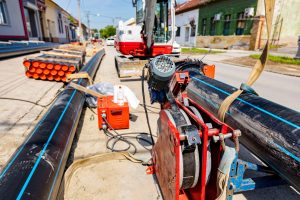
When a pipe fails unexpectedly, every minute counts. Water escaping under pressure can cause extensive damage, disrupt operations, and create safety hazards. The traditional response—locating isolation valves, shutting down sections of the system, draining pipework—takes time that you may not have. This is where pipe freezing offers a compelling alternative: a rapid, non-invasive technique that can isolate a section of pipe within minutes, allowing emergency repairs to proceed without the delays and complications of conventional shutdown.
At RDS Pipeline, we’ve used pipe freezing to resolve countless emergency situations across domestic, commercial, and industrial settings. In this guide, we’ll explain how the technique works and explore the significant advantages it offers when time is of the essence.
How Does Pipe Freezing Work?
Pipe freezing uses liquid nitrogen or carbon dioxide to rapidly reduce the temperature of a small section of pipe, freezing the water inside and creating a solid ice plug. This plug acts as a temporary barrier, effectively isolating the section of pipe downstream and stopping flow without the need to close valves or drain the system.
The freezing equipment—typically a jacket or clamp—is applied to the outside of the pipe at the chosen location. Refrigerant is then circulated through the jacket, drawing heat from the pipe and its contents. Within minutes, depending on pipe diameter and flow conditions, a robust ice plug forms. This plug can maintain isolation for as long as the freezing equipment remains in place, giving engineers time to carry out repairs, replacements, or modifications.
Once the work is complete, the equipment is removed and the ice plug thaws naturally, restoring normal flow. The pipe itself is undamaged—no cutting, no welding, no permanent alteration to the system.
The Key Advantages of Pipe Freezing for Emergency Repairs
Rapid Response When Time Is Critical
In an emergency, speed is everything. Traditional isolation methods require locating valves—which may be distant, difficult to access, or seized through lack of use—and then waiting for the affected section to drain. This process can take hours, during which damage continues to accumulate.
Pipe freezing can achieve isolation in a fraction of that time. A skilled technician can have an ice plug formed and holding within fifteen to thirty minutes in many cases. For emergency repairs, this speed translates directly into reduced damage, lower costs, and faster resolution of the crisis.
No System Shutdown Required
One of the most significant advantages of pipe freezing is that it creates localised isolation without affecting the broader system. Unlike closing a main valve, which may cut supply to an entire building or facility, pipe freezing targets a precise section of pipework. Areas upstream and downstream of the freeze point can continue operating normally.
This targeted approach is invaluable in settings where continuous supply is critical. Hospitals, data centres, manufacturing facilities, and multi-occupancy buildings all benefit from the ability to isolate and repair a problem without widespread disruption. Tenants, patients, or production lines unaffected by the immediate issue can carry on as normal.
Non-Invasive and Damage-Free
Pipe freezing requires no cutting, welding, or permanent modification to the pipework. The freezing jacket simply clamps around the outside of the pipe, and when the job is done, it’s removed without trace. The pipe itself remains intact and unaltered.
This non-invasive nature brings several benefits. There’s no need to make good after the repair—no welding inspections, no pressure testing of new joints, no repainting or insulation replacement. The system returns to exactly the condition it was in before the freeze, minus whatever fault prompted the emergency in the first place.
Works Where Valves Are Inaccessible or Absent
Older pipework installations don’t always feature the isolation valves that modern best practice would specify. Even where valves exist, they may be buried, built over, or simply stuck fast after years without operation. In these situations, traditional isolation becomes difficult, time-consuming, or impossible.
Pipe freezing sidesteps the problem entirely. As long as there’s an accessible section of pipe where the freeze jacket can be applied, isolation can be achieved regardless of valve availability. This makes pipe freezing particularly valuable for emergency repairs on legacy systems or in buildings where original drawings no longer reflect reality.
Suitable for a Range of Pipe Materials and Sizes
Modern pipe freezing techniques work effectively across a variety of pipe materials, including copper, steel, plastic, and iron. Pipe diameters from small domestic supplies up to larger commercial mains can all be frozen successfully with appropriate equipment.
This versatility means pipe freezing can address emergencies in diverse settings—from a burst pipe in a residential property to a failed section of pipework in an industrial plant. The same fundamental technique applies, scaled and adapted to suit the specific circumstances.
Environmentally Responsible
Because pipe freezing creates isolation without draining the system, there’s no water wastage and no need to dispose of contaminated or treated water. The contents of the pipe stay exactly where they are, with only a small section temporarily solidified.
For environmentally conscious organisations—or those handling water that requires treatment before discharge—this represents a meaningful advantage. Emergency repairs can proceed without generating waste or triggering environmental compliance concerns.
Cost-Effective Emergency Solution
The speed and simplicity of pipe freezing translate into genuine cost savings. Less time on site means lower labour costs. Avoiding system-wide shutdown means no lost production or service interruption. Eliminating drainage and refilling saves water and associated treatment costs. No permanent pipe modifications means no materials, welding, or inspection expenses.
When you’re already facing the unexpected cost of an emergency repair, keeping ancillary expenses to a minimum matters. Pipe freezing delivers effective isolation economically as well as practically.
When Is Pipe Freezing the Right Choice?
Pipe freezing excels in emergency situations where speed and minimal disruption are priorities. It’s ideal when isolation valves are unavailable, inaccessible, or unreliable. It’s the natural choice when you need to maintain supply to unaffected areas while addressing a localised problem.
That said, pipe freezing isn’t suitable for every scenario. Pipes with very high flow rates may be difficult to freeze effectively. Certain pipe conditions or materials may require alternative approaches. A professional assessment ensures the right technique is matched to the specific situation.
Trust RDS Pipeline for Emergency Pipe Freezing
At RDS Pipeline, we maintain the equipment, expertise, and round-the-clock availability that emergency situations demand. Our technicians are experienced in pipe freezing across domestic, commercial, and industrial applications, and we pride ourselves on rapid response when our clients need us most.
If you’re facing a pipe emergency—or want to discuss how pipe freezing could feature in your contingency planning—contact RDS Pipeline today. We’re here to help when it matters most.